


The Importance of Crop Yield Mapping in UK Agriculture
What is Yield Mapping and why is it Important in Agriculture?
As pressure mounts on the farming industry to become more efficient and profitable, many new technologies have been developed to support growers through the ongoing transition.
Much of this involves doing ‘more with less’, with farmers constantly encouraged to reduce fertiliser, pesticide, and fuel use.
This has led many farmers to take a precision agriculture approach, relying on data collection to inform future decision making, particularly around crop inputs.
By tailoring inputs, farmers can optimise plant yield and health, while at the same time reducing the total amount of fertiliser and pesticides applied to the crop, driving better margins and improved environmental outcomes.
In this article, we look at a core tenant of precision agriculture, yield mapping, and how it is helping farmers improve their businesses for long term sustainability.
Precision farming and yield mapping
Although precision farming and yield mapping are not the same thing, they are closely related.
Yield mapping involves the collection of yield data at harvest time. This is done by technologies such as GPS and yield monitors on a combine harvester recording the levels of crop produced – either in weight or volume – at various points in the field.
From this, yield maps can be created which are used as guides for following crops, but are also a good check on the previous year to see what’s done well and try and figure out why. This enables farmers to tailor crop inputs to the parts of the field where yields are likely to be lowest.
Precision farming, a huge and ongoing revolution in agriculture, is the practice of taking the data in the yield maps and tailoring the inputs, be that seed, fertiliser or pesticides, in line with it, in an attempt to optimise crop yield and performance while making the most efficient use of expensive inputs as possible.
In theory, this approach leads to better decisions and better outcomes including higher margins for the farmer, less nutrients leaching and wastage, and better environmental outcomes compared to applying inputs at a one-size-fits-all, whole crop level.
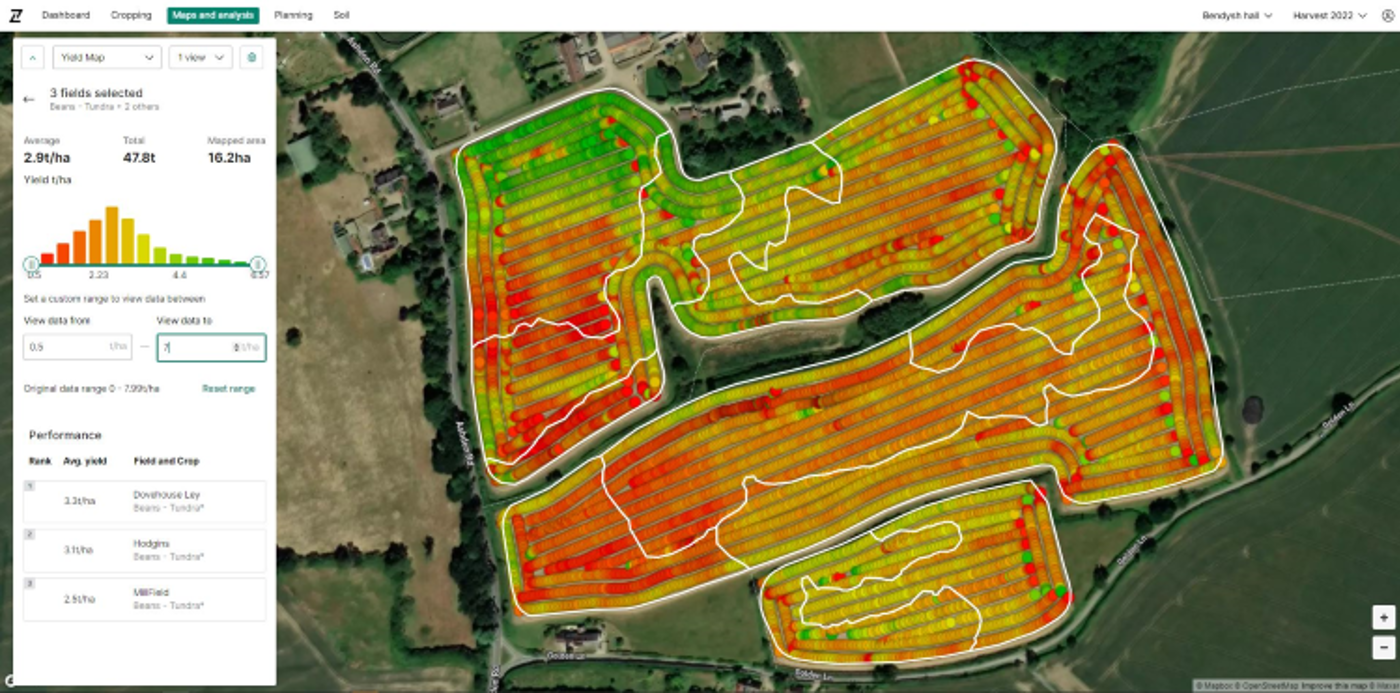
Contour Yield Map
Crop Yield Mapping
For precision farming to be most effective, crop yield mapping should be carried out over successive years to build up a complete picture about different crop performance across a farm.
This will enable farmers and agronomists to determine if certain crops perform better in specific areas of a farm and what factors impact on their development and yield. Ultimately, it will help them decide what to plant where, as part of their rotation.
It will also enable growers to identify what inputs have the most impact and what are not worth repeating.
Over time, the data accumulated, combined with the experience of the grower, ensures future decision making is as optimal as possible.
How to produce a crop yield map
The quality of a crop yield map is only as good as the data that goes into it, and platforms like RHIZA’s Contour can help ensure the data is optimised and therefore the map is insightful and accurate.
However, with that in mind, here are a few tips to help you create an accurate yield map:
- Be accurate with field boundaries
You must take into account margins and buffers which are being left for any reason, such as stewardship or SFI schemes. - Take note of any permanent fixtures in the field
The plan must take into consideration permanent fixtures such as telegraph poles, pylons, hedges, water sources, etc. - Ensure your yield monitor is working correctly
The yield monitor can get overlooked during regular machinery maintenance, so it is beneficial to check or service the yield monitor before you start. - Modern combines and older machines record data differently
Bear this in mind when collecting the data and any allowances you need to make for the performance of the machine. Take care when entering fields and negotiating gates as the way you do this could affect the data.
Once the data is collected, a software programme will analyse it and create the maps.
Maps will be created on screen, but you can print paper copies or access them on a mobile device.
Yield-mapping software
Choosing a software system you’re comfortable with will pay dividends in the long run, but as digital technology for agriculture has developed at such a rapid rate recently, it can get confusing.
So, take your time and take advice as to which system will suit you best.
However, here are some of the most popular.
Farmplan’s Gatekeeper platform has basic features which allow you to communicate with your agronomist, monitor stock and manage staff workflows. However, for mapping tools, you need to opt for add-ons to your package.
ADAS Agronomics software allows farmers to test their own ideas for growing better yields. It uses yield maps, satellite and drone data to assess the benefits of different treatments on a variety of crops.
A number of manufacturer’s own brand platforms, like John Deere Ops Centre or Claas Connect, also allow you to create maps showing plots, field access points, environmental features, slug and weed levels amongst other factors. You can layer these maps to allow you to consider all the factors as a whole.
RHIZA’s Contour platform includes a soil map of all soil types in the UK which help in producing a yield map for individual fields. It also has the capacity to store essential, historical data enabling users to build up in depth yield maps over successive years.
Costs for all vary depending on the level of detail and information you require, some are free to download apps whereas others are available on a subscription method. Others require one-off payments.
With our RHIZA services, we have developed Contour and Contour Mobile.
Using satellite imagery, we offer mapping services with the option to add in hyper-local weather data, pest and disease information, soil testing and detection of in-field variables.
Summary
Yield mapping is one of the most useful tools available to farmers in modern day farming and is an integral part of a precision agriculture approach.
The ability to map out land, farms and fields and combine this with data about crop performance enables interventions and treatments to be made where they are needed most and is key to having a more profitable and sustainable farming business.
It is also crucial for enhancing the environmental performance of a farm.
The are many software options available to help with yield mapping and precision farming, but care must be taken in determining which one is the best for your business.
RHIZA Digital Farming Knowledge Hub - Practical Guides and Insights
For those looking to explore the detail, we’ve created a growing library of technical guides covering soil performance, crop monitoring, compliance and precision decision support.
Digital Farming Knowledge Hub - Precision Agriculture Tools

Precision Agriculture

Using Satellite Imaging

What is Yield Mapping

Using Crop Growth Models

Crop Management Systems

Benefits of Using a Scouting APP
