


Using Crop Growth Models to Maximise Yield Potential
For centuries, farmers have relied on experience and the wisdom drawn from generations to make decisions about making the most of their land.
And whilst that knowledge is still exceptionally valuable, the landscape of farming is changing. Farmers need to change with it by combining their hard-won knowledge with new technological and data-based solutions.
One of the most powerful digital tools farmers can adopt is the crop growth model, which enables predictions to be made about crop development under changing conditions.
But how does it work and what benefits does this bring? In this blog, we take a look.
What Are Crop Growth Models?
Put simply, a crop growth model is a mathematical tool than can calculate how crops will grow under different conditions. By breaking down all the factors across the farm, crop types and weather conditions into a series of complex equations, the software can simulate how a specific crop will grow and develop over time.
Crop growth models factor in a wealth of data that includes soil type, structure and conditions; weather data for that farm; crop genetics, photosynthesis, respiration and water uptake; and key management practices like fertiliser inputs.
By taking all of these variables into consideration, the crop growth model can then predict crop development, biomass accumulation, nutrient uptake, and ultimately yield, based on both natural and managed conditions.
Essentially, crop growth models are fortune telling tools for farmers, enabling them to gaze into a crystal ball and get answers to the agonising questions that keep them awake at night like ‘what if I plant earlier’, ‘what if I switch to a new variety’ or ‘given the weather conditions, when should I apply nitrogen?’.
Crop Growth Simulation Models: Taking It Further
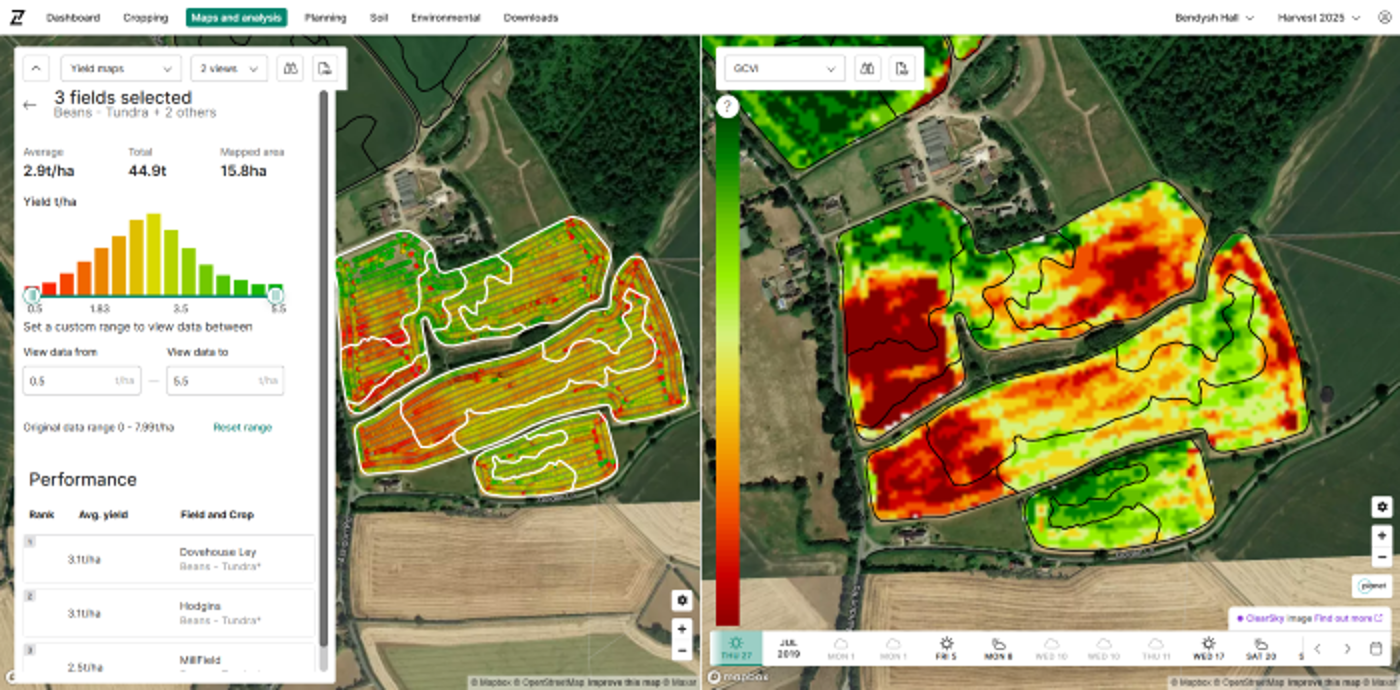
There can often be confusion between crop growth models and crop growth simulation models and while the terms can be interchangeable, a crop growth simulation model typically refers to a more advanced crop growth model that allows for more dynamic forecasting across an entire growing season - or even multiple seasons.
Crop growth simulation models will typically use far greater data sets, incorporating real-time and historical data to simulate crop growth over much greater periods, and showing how crops would respond to daily changes and farming interventions.
These higher-level simulations have primarily been used in research applications but are increasingly being used on farms and through smart farming tools to accurately forecast yields and test crops against different soil types, fertiliser regimes and sowing strategies.
Why Use Crop Growth Models on Your Farm?
While crop growth models may feel like something out of a sci-fi film or the exclusive preserve of computer scientists, farmers are actually the ones who can benefit the most.
By using the insights gained from crop growth models, farmers can grow yields while managing costs and this helps to protect the future of the farm and find profit in hard times.
With continuing political uncertainty, deepening losses in farm funding and a shifting climate, crop growth models actually provide farmers with something they can predict.
By working with RHIZA or agronomists, farmers can use crop growth models in a number of ways. Perhaps most important is the ability to more accurately predict yields from each crop. By combining weather and soil data with your crop variety and management plan, the model will predict likely yields prior to the key spraying month of May, allowing chemical spend to be more efficiently managed.
It will also enable you to reduce waste and save money by testing out different fertiliser regimes, making sure you don’t over- or under-apply nitrogen. This also brings about significant environmental benefits by reducing the risk of run-off or leaching.
Risk management is also a key benefit. By better understanding how your crops would respond to dry or wet spells, or other key stresses, you can adapt your farming practices accordingly and mitigate any potential threats.
How Do I Use A Crop Growth Model?
The good news is that you don’t have to invest a tractor-sized budget into a new state-of-the-art computer or head back to school to get a masters in agronomy and computer science.
A number of farming tools, including RHIZA, integrate crop growth model technology into their farmer-friendly platforms or your agronomist will most likely be able to access a crop growth model you can both explore.
To get started, you’ll need a range of data sets including:
- Soil data – texture, depth, organic matter, drainage
- Weather data – historical or real-time from local weather stations
- Crop management info – sowing date, variety, fertiliser & irrigation schedules
Once you have this, you can then work with your agronomist to start inputting the data and use the predictions it delivers to make better informed decisions on your own farm.
Crop growth models are becoming an integral part of precision farming tools so its worth exploring what it can mean for your farm now.
Crop Growth Models: The Future of Yield Prediction
The benefits of crop growth models are clear for the farming sector and that means the modelling systems are only going to get smarter, offering greater accuracy and deeper insights.
With the huge advances in artificial intelligence, the proliferation of remote sensing and data capture across every piece of farm technology and the growth of real-time data integration, we’re heading toward a far more connected farming future.
This means farmers will be able to use these models to get live alerts for crop stress based on model predictions, auto-adjust irrigation and fertilisation via variable rate technology and, ultimately, run entire-season simulations in seconds using satellite imagery and soil sensors.
In short, using crop growth models will means better insights, faster action and more productive and profitable farms.
In Summary
Crop growth models are already a proven technology that are helping farmers to trial new crops and rotation strategies, fine-tune inputs, or manage risk across an unpredictable season.
They are a practical and increasingly accessible resource and, as farming margins tighten and climate pressure grows, crop growth models are becoming seen as a necessity rather than a luxury.
We are moving beyond the precision agriculture revolution and on to the advanced agriculture generation where data, AI and predictive models will become key to preserving the future of farming.
Crop growth models are one of the most powerful tools in this movement and will be critical for ensuring UK farmers can grow smarter, more sustainably, and more profitably.
Our RHIZA service has an array of digital tools that help to provide an unparalleled level of insight into farming operations.
RHIZA Digital Farming Knowledge Hub - Practical Guides and Insights
For those looking to explore the detail, we’ve created a growing library of technical guides covering soil performance, crop monitoring, compliance and precision decision support.
Digital Farming Knowledge Hub - Precision Agriculture Tools

Precision Agriculture

Using Satellite Imaging

What is Yield Mapping

Using Crop Growth Models

Crop Management Systems

Benefits of Using a Scouting APP
