


An Overview of Agricultural Soil Testing & Sampling
Soil health is perhaps the most important and influential factor in the success of a growing operation. Without healthy soil, nutrients and water cannot reach the plant roots effectively, inhibiting nutrient take up and compromising crop yield and quality.
But what is healthy soil and how do you know if you have it or not?
In this article, we take a look at soil sampling to find out what it measures and what it can tell us.
What is soil sampling in agriculture?
Soil sampling involves taking a soil sample from your farm and carrying out a number of tests to determine its nutrient content, its chemical, physical and biological properties, and the pH.
Simple tests can be carried out by a grower on-farm, but for more in-depth analysis, samples are sent away to a specialist lab.
The results of the lab tests are analysed, interpretated and compiled into a report which will give indications of the steps the farmer needs to take to best optimise the health of the soil health on their farm.
Importance of soil sampling in UK agriculture
The importance of soil testing as a means of optimising crop production cannot be underestimated.
Soil sampling reveals the levels of key nutrients already in the soil, such as nitrogen, phosphorus, potassium, and magnesium, and can form the basis of a nutrient input schedule.
With fertiliser constituting a significant cost to farmers, bringing efficiencies to its use can help increase yields, cut costs and increase margins significantly.
Optimising soil pH is another important function of soil sampling. By understanding existing pH and how this impacts on the crops to be grown, and how to alter it, will have a big impact on crop yield and quality.
But it’s not just crop health that soil sampling can help with. It can also give insights into environmental issues.
For example, understanding the nutrient concentrations in the soil, and building a nutrient input plan based on that, can reduce leaching into local watercourses and other areas in the environment.
Understanding how well soil holds water can help growers to understand irrigation requirements, what will happen in the event of a prolonged drought, and how well the soil holds water during times of heavy rainfall, helping to prevent flooding.
Finally, soil sampling can help farmers access funding. Many environmental land management schemes require soil testing to ensure farming operations are compliant with the standards the schemes require. Without this, funding will not be forthcoming.

RHIZA Soil Scanning at Braiseworth Orchards
Soil Testing Equipment
Although most in-depth soil testing takes place at a laboratory, it is possible to carry out certain tests yourself. To do this, there is a wide range of equipment available on the market ranging from kits you can buy on Amazon for under £10 to ones where you would see little change from £20,000.
However, soil testing at its most basic can be carried out with three pieces of equipment – a pH tester and a bucket and spade.
Once you’ve collected your sample, simply wrap it securely and send it to a lab.
pH can be tested with a digital metre, which is one of the more accurate ways to do it. Readings should be taken from a number of locations across a farm to check for variations.
A pH test can also be carried out with pH test strips, and whereas these are quick and easy and do give an indication of acidity and alkalinity levels, they’re not as accurate as a digital metre.
Measuring soil temperature is useful because it gives insights into when to drill and when to apply inputs to a crop.
Advanced, laboratory-based soil sampling can build significantly on these tests if required, although such in depth analysis is rarely needed for successful crop production. Also, advanced testing does add cost to the overall costs of sampling, so decision need to be made around what information is essentially and what is not.
How To Take Soil Samples
Taking a soil sample to send to the lab is relatively simple and is usually carried out with a soil core sampler or soil auger.
Both of these produce a soil sample but work slightly differently.
The core sampler is manually pushed into the ground and withdraws soil undisturbed from different depths.
The auger, operated manually or mechanically, is twisted into the ground like a screw to collect the soil. For arable soils, testing at a depth of 15cm is recommended. When you remove the auger, tap off the soil to create a mixed sample.
A soil auger with an extension can drill deeper into the ground allowing for samples to be taken up to ten feet below the surface.
It is also possible to take a sample using a spade or trowel. Experts advise the cut should be between two to three centimetres wide and down to the required depth.
Once you have decided upon the method, other items you need include a bucket for collecting the soil sample, clean plastic bags and a marker pen.
Depending on the size of the field or area you want to test, it is a good idea to take multiple samples at different points. Mix the samples in a bucket to produce a representative field sample, then bag it and write the location on the bag. The ideal soil sample size is equivalent to two handfuls.
Avoid taking samples just after a lime or fertiliser application and get rid of stones, rubble and roots before you bag up the sample and send it off.
Producing a soil test report
There are a number of specialist companies across the UK where you can send the sample, and some will even collect it. Most UK soil laboratories are members of the Professional Agricultural Analysis Group (PAAG).
It is a legal requirement to do basic soil analysis for phosphorus (P), potassium (K), magnesium (Mg) and the pH level, so this is the minimum information you should expect in a soil analysis report.
Sodium levels will also often be tested in a basic soil analysis.
However, a broad-spectrum also covers a host of other nutrients and micronutrients, such as phosphorous, potassium, calcium, magnesium, sulphur, boron, copper, iron, manganese, molybdenum, zinc, and sodium, as well as Cation Exchange Capacity (CEC), pH, and organic matter.
As well as providing readings, a good report will also provide comments to help interpret results and offer advice and suggestions on how to improve the health of your soil to optimise crop production.
Storing soil sampling reports
Collecting and collating all this data is useful and gives important insights into the condition of soil, which can be used to make better growing decisions.
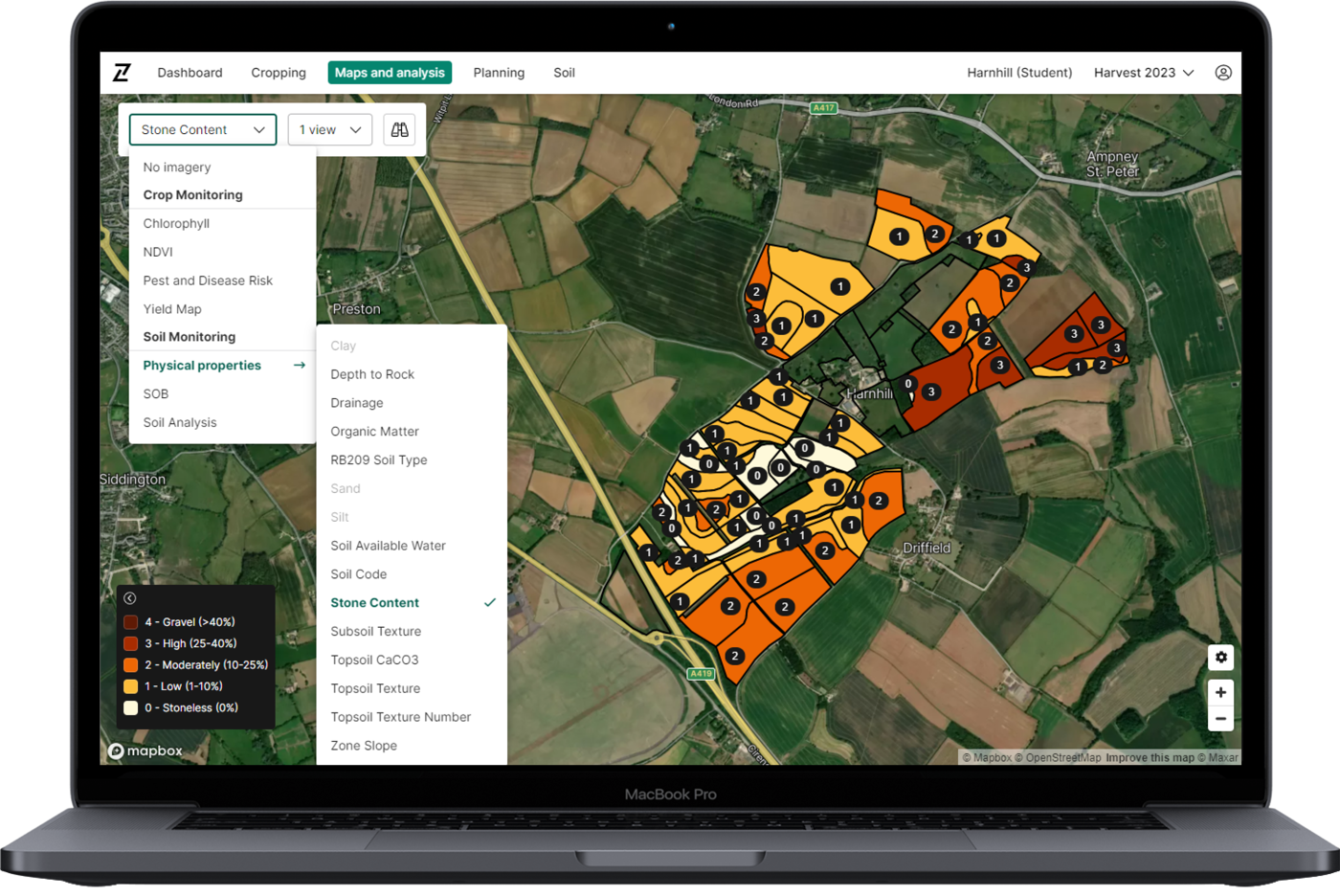
However, this can be enhanced with the use of digital tools such as RHIZA’s Contour platform, which not only enables the safe and easy storage of soil sampling data, but also interpretation of the data to optimise approaches to crop production.
This results in data that is fully utilised across the entire farm to produce the best cropping outcomes, while taking the heavy lifting of data analysis and interpretation off the farmer, enabling them to concentrate on producing the best crops possible.
RHIZA Digital Farming Knowledge Hub - Practical Guides and Insights
For those looking to explore the detail, we’ve created a growing library of technical guides covering soil performance, crop monitoring, compliance and precision decision support.
Digital Farming Knowledge Hub - Soil and Nutrient Foundations

Agricultural Soil Testing & Sampling

Soil Mapping in Agriculture

EC Levels in Soil - Measurement, Scanning & Testing

The Importance of Soil pH

What is Potash?
